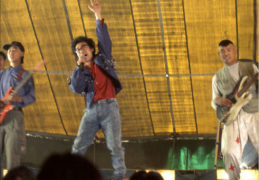
L’action du deuxième film de Jia Zhang-Ke a encore pour décor la région de Fenyang, tout en déplaçant sa temporalité à la décennie 1980. Centré sur le destin d’une troupe de théâtre provinciale passant de la propagande maoïste à la découverte de la pop influencée par l’Occident, Platform évoque avec force le désir de liberté d’individu·e·s contrarié par les pesanteurs collectives.
Le deuxième long métrage de Jia Zhang-Ke est sans doute son plus autobiographique. Parce qu’il se déroule pendant la décennie 1980 au sortir de la Révolution culturelle, dont il est l’un des enfants. Il met en scène le délitement progressif d’une troupe de théâtre amateur de Fenyang – dont le modèle provient de son histoire familiale – qui délaisse les spectacles de propagande, se privatise, et tente de se renouveler en collant aux nouvelles modes culturelles imprégnées des airs pop venus d’un ailleurs, hors-champ. Cette toile de fond sert d’écrin au récit qui s’enroule autour des relations entre deux couples, en particulier celui formé par Cui Mingliang (Wang Hongwei) et Yin Ruijuan, incarnée par Zhao Tao, qui deviendra l’égérie de Jia Zhang-Ke dans ses œuvres futures. Découpé en plans-séquences tournés au 35 mm, il dévoile avec force la tension éprouvée par une génération qui se prend à rêver d’un destin individuel, mais dont l’affirmation erratique se heurte aux pesanteurs collectives héritées du passé. Film empreint du spleen des attentes déçues, Platform cristallise l’expérience de l’inexorable fuite du temps.
Emmanuel Chicon
Jia Zhang-Ke’s second film is again set in the Fenyang region, but shifts its focus to the 1980s. Centred on the fate of a provincial theatre troupe as it moves from Maoist propaganda to the discovery of Western-influenced pop music, Platform powerfully evokes the individual’s desire for freedom thwarted by collective constraints.
Jia Zhang-Ke’s second feature is undoubtedly his most autobiographical. It is set in the 1980s, at the tail end of the Cultural Revolution, of which he was one of the children. It depicts the gradual disintegration of an amateur theatre company in Fenyang – whose model is derived from his own family history – as it begins to abandon propaganda shows, become privatised, and attempts to renew itself by embracing new cultural trends imbued with pop tunes from elsewhere. This is the backdrop for the story, which revolves around the relationship between two couples, notably that formed by Cui Mingliang (Wang Hongwei) and Yin Ruijuan, played by Zhao Tao, who would become Jia Zhang-Ke’s muse in his subsequent work. Divided into 35 mm sequence shots, the film powerfully reveals the tension felt by a generation daring to dream of an individual destiny, but whose erratic affirmation clashes with the collective burdens inherited from the past. A film imbued with the angst of thwarted expectations, Platform crystallises the experience of the inexorable passage of time.
Emmanuel Chicon
Die Handlung von Jia Zhang-Kes zweitem Film spielt nach wie vor in der Region Fenyang, diesmal allerdings in den 1980er-Jahren. Im Mittelpunkt steht das Schicksal einer Provinztheatergruppe, die sich von der maoistischen Propaganda abwendet und westliche Popmusik für sich entdeckt. Platform erzählt eindringlich vom individuellen Freiheitsdrang, der durch kollektive Zwänge behindert wird.
Platform
Zhantai
Zhang-Ke Jia
Zhang-Ke Jia
Yu Nelson Lik-wai
Kong Jinlei
Zhang Yang
Li Kit-Ming
Ruggle Meret