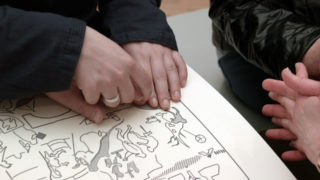
La Tentation de saint Antoine est un triptyque du peintre néerlandais Jérôme Bosch, exposé au Musée national des arts anciens de Lisbonne. Il reproduit de façon visionnaire les tentations du saint homme dans le désert, en jouant sur l’allégorie religieuse, les symboles mystiques de son époque et le goût populaire pour l’illustration. Plus qu’une image réelle il est une image mentale. C’est donc de cette image mentale, qui se transforme vite en imagination, que traite Anthony, the Invisible One, dans lequel une guide présente le célèbre tableau à trois publics différents: des personnes voyantes, des aveugles et un homme sourd et aveugle. Avec des clefs d’accès spécifiques pour chaque public, l’œuvre est dévoilée peu à peu. En dix-sept minutes (telle est la durée de ce court métrage) une question ne cesse d’apparaître sans être posée : que signifie voir, dans le domaine de l’art? La perception d’une œuvre d’art correspond-elle à une approche visuelle? Ou passe-t-elle plutôt par le monde des idées et l’imagination? La réponse est peut-être dans une stupéfiante révélation finale.
Luciano Barisone
The Temptation of Saint Anthony is a triptych by the Dutch painter Hieronymus Bosch, exhibited in the National Museum of Ancient Art in Lisbon. In a visionary manner, it reproduces the temptations of the holy man in the desert by playing with the religious allegory, the mystical symbols of his age and the popular taste for illustration. More than a real image, it is a mental image. This mental image, which transforms very quickly into imagination, is therefore the subject of Anthony, the Invisible One, in which a guide presents the famous painting to three different audiences: sighted people, blind people, and a deaf and blind man. With access keys that are specific to each audience, the work is gradually unveiled. In seventeen minutes (such is the length of this short film), a question emerges again and again, without being asked: in the field of art, what does seeing mean? Does the perception of a work of art correspond to a visual approach? Or does it instead involve the world of ideas and imagination? The answer is perhaps in a stupefying final revelation.
Luciano Barisone
Die Versuchung des Heiligen Antonius ist ein Triptychon des niederländischen Malers Hieronymus Bosch, das in Lissabon im Staatlichen Museum für Alte Kunst ausgestellt ist. Über das Spiel mit der religiösen Allegorie, den mystischen Symbolen der damaligen Zeit und der allgemein beliebten Illustration zeigt es eine visionäre Abbildung des Heiligen in der Wüste. Ein Bild, das vor allem ein geistiges ist. Von diesem geistigen Bild ausgehend, das sich rasch zu einem imaginären Gebilde wandelt, handelt Anthony, the Invisible One, in dem ein Kunstführer das berühmte Gemälde drei unterschiedlichen Kategorien von Betrachtern präsentiert: sehende und blinde Personen und ein tauber und blinder Mann. Mit jeweils spezifischen Schlüsseln für jedes Publikum wird das Werk Stück um Stück enthüllt. Während dieser siebzehn Minuten (so lange dauert der Kurzfilm) steht eine Frage ständig im Raum, wird aber nie gestellt: Was bedeutet Sehen im Bereich der Kunst? Hat die Wahrnehmung eines Kunstwerks mit einem visuellen Ansatz zu tun? Oder nimmt sie vielmehr den Weg der Ideen und der Vorstellungskraft? Die Antwort liegt möglicherweise in einer verblüffenden abschliessenden Enthüllung.
Luciano Barisone
Sergio Da Costa
Maya Kosa