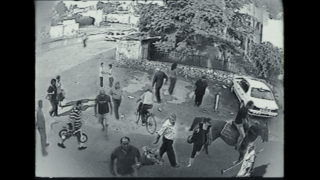
Suite à un acte de vandalisme, le père du cinéaste palestinien décide d’installer une caméra de surveillance pour enregistrer les scènes se déroulant devant la maison. Le quotidien familial, ou les voisins se rendant au travail, An Unusual Summer capte les moments de poésie fugaces, tandis qu’en toile de fond affleure la chorégraphie du quotidien de Ramla, ville sur territoire israélien.
Suite à un acte de vandalisme, le père du cinéaste se résout à installer une caméra de surveillance pour enregistrer les scènes se déroulant devant la maison. Le quotidien familial, les voisins se rendant au travail, et les enfants à l’école, An Unusual Summer capte les moments de poésie fugaces, tandis qu’en toile de fond affleure la chorégraphie du quotidien dans le quartier arabe – que d’aucuns nomment « ghetto » – de Ramla, dans le territoire actuel d’Israël. Composant avec ce matériau visuel à l’esthétique basse définition, finement jalonné de bruitages, Kamal Aljafari livre le journal mécanique d’une vie qui défile devant la fenêtre, et parvient avec patience et grâce infinie, à transfigurer un film « à dispositif », en une fresque personnelle et éminemment politique. « Dans un passé lointain, il y a des années, devant cette maison se tenait un figuier dans le jardin, qui a désormais disparu. Un bulldozer l’a fait disparaître, tel un souvenir, balayé par l’Histoire et le Temps. »
Emilie Bujès
Following an act of vandalism, the Palestinian filmmaker’s father decides to install a surveillance camera to record the scenes unfolding in front of the house. Everyday family life, or neighbours going to work, An Unusual Summer captures fleeting moments of poetry whereas, in the background, the daily choreography of Ramla, located in today’s Israël, comes to the surface.
Following an act of vandalism, the filmmaker’s father decides to install a surveillance camera to record the scenes unfolding in front of the house. Everyday family life, the neighbours going to work, and the children at school, An Unusual Summer captures fleeting moments of poetry whereas, in the background, the daily choreography of the Arab district—that no one some name the “ghetto”—of Ramla, in current Israeli territory, comes to the surface. Composing with this visual material of low-definition aesthetics, finely punctuated with sound effects, Kamal Aljafari creates a mechanical diary of a life that scrolls past the window and succeeds with patience and infinite grace in transfiguring a ‘film à dispositif’ based on a security device into a personal and eminently political fresco. “In the distant past, many years ago, in front of this house, there stood a fig tree in a garden, which has now vanished, bulldozed into memory, and swept up by History and Time.”
Emilie Bujès
Nach einem Fall von Vandalismus beschloss der Vater des Filmemachers, eine Überwachungskamera anzubringen, um die Vorgänge vor dem Haus zu filmen. An Unusual Summer fängt den Alltag der Familie ein, zeigt Nachbarn, die zur Arbeit und Kinder, die zur Schule gehen, spiegelt Augenblicke von flüchtiger Poesie in der Choreografie des Alltags im von einigen als Ghetto bezeichneten arabischen Viertel von Ramla im heutigen Israel. Kamal Aljafari konstruiert aus diesem Bildmaterial, das mit niedriger Auflösung gefilmt wurde und von diskreten Tonelementen begleitet ist, das mechanische Tagebuch von Leben, das sich vor dem Fenster abspielt. Geduldig und mit unendlicher Anmut gelingt es ihm, einen „Überwachungskamerafilm” in ein intimes und durchaus politisches Fresko zu verwandeln. „In ferner Vergangenheit, vor vielen Jahren, stand vor diesem Haus ein Feigenbaum in einem Garten, der dem Erdboden gleichgemacht wurde, den Geschichte und Zeit in der Versenkung verschwinden liessen, der nur noch eine Erinnerung ist.”
Emilie Bujès
Kamal Aljafari
kamal aljafari