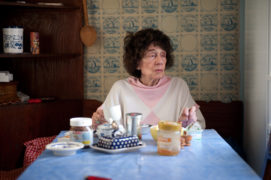
Comment réaliser un portrait au cinéma ? Comment raconter, à travers une seule personne, la petite et la grande histoire ? Une jeune femme tente de questionner sa grand-mère d’origine juive, qui a vécu le nazisme et la guerre. Dans le même temps, l’apprentie réalisatrice se confronte à son personnage haut en couleurs qui n’entend nullement se laisser diriger. Dans une maison chargée d’objets et de souvenirs, où tout respire une époque révolue, la vieille dame se dérobe, comme ce XXe siècle tragique et lointain que sa petite-fille voudrait appréhender. Dès lors, pour combler les manques, le film apporte ses propres réponses, par un brillant jeu de mise en scène et de montage, une bonne dose d’humour et un bel art de la suggestion. Où l’on devine, par delà les résistances et les non-dits, une histoire de souffrance, de refoulement, mais aussi d’émancipation. Un film drôle et profond sur la volonté de savoir, l’héritage de la mémoire, et les difficultés de la transmission : car entre deux générations que tout sépare, le désir de dialogue ne peut à lui seul dénouer le mystère de l’histoire.
Alessia Bottani
How does one use film to draw a portrait? How does one convey the life of an individual and the bigger picture? A young woman tries to question her Jewish grandmother, who has lived through Nazism and the War. At the same time, the apprentice director has to contend with a strong-willed character, who has no intention of being “directed”. In an old house crammed with things that bear witness to the past, the old lady proves evasive, like the tragic and distant 20th century her granddaughter would like to grasp. To fill the gaps, the film has to provide its own answers, through brilliant staging and editing, plenty of humour and the subtle art of suggestion. Under the reluctance and things left unsaid, we detect a story of suffering, repression, but also of emancipation. A wry and profound film on the desire to know, the legacy of memory and the difficulty of communication across the generations: the willingness to enter into dialogue is not alone enough to disclose the secrets of history.
Alessia Bottani.
Translation BMP Translations
Wie macht man ein Filmporträt? Wie erzählt man, mit der Hilfe einer einzigen Person, die Geschichte in Geschichten? Eine junge Frau versucht ihre Grossmutter jüdischer Herkunft zu befragen, die Krieg und Naziherrschaft überlebt hat. Gleichzeitig muss sich die angehende Regisseurin mit deren schillernder Persönlichkeit auseinandersetzen, die sich keine Vorschriften machen lässt. In einem Haus voller Krimskrams und Erinnerungen, wo alles an eine vergangene Epoche erinnert, beginnt sich die alte Dame ihrer Enkelin zu entziehen, genau wie jenes tragische und ferne 20. Jahrhundert, das diese gern verstehen möchte. Um die Lücken zu füllen, liefert der Film fortan eigene Antworten, mittels brillanter Inszenierung und Schnitttechnik, aber auch mit einer beachtlichen Prise Humor sowie Suggestion vom Feinsten. Jenseits von Widerstand und Verschweigen erahnt man eine Geschichte voller Leid, Verdrängung, aber auch Emanzipation. Ein sonderbarer, tiefgründiger Film über das Wissen-Wollen, die Weitergabe von Erinnerungen und Kommunikationsschwierigkeiten: Denn bei zwei Generationen, die so vieles trennt, kann der Wunsch nach einem Dialog allein nicht alle Geheimnisse der Geschichte lüften.
Alessia Bottani
Übersetzung BMP Translations
Laura Laabs
Johannes Frodl
Cristina Marx