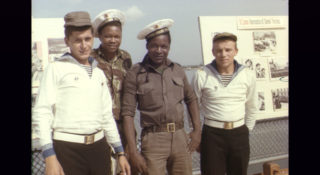
Longtemps ignorée par l’URSS, l’Afrique subsaharienne entre, avec les indépendances des années 1960, dans la vie quotidienne des Soviétiques, qui partent par milliers pour Bamako, Accra ou Conakry, aider les Africains à « construire le socialisme ». Alexander Markov a prélevé les fragments argentiques de cette époque dans une centaine de films réalisés par les opérateurs soviétiques pour témoigner de la générosité des programmes d’aide humanitaire destinés au continent noir. Découpé en chapitres, « Our Africa » narre cette épopée entre 1960 et la fin de l’URSS (1991). Se succèdent à l’écran, les simples soldats de la coopération magnifiés et la ronde des personnages plus illustres: Nkrumah, Lumumba, Nasser, Khrouchtchev, Brejnev…Pas dupe, Markov remonte cette belle matière pour en débusquer les ressorts propagandistes. La répétition de certaines scènes appelle l’ironie, fille de la distance et du temps : cette « Grande Utopie » collective fut l’œuvre d’une poignée de dirigeants inamovibles, dont la figure tutélaire devait pourtant être déboulonnée, elle aussi, comme les statues des ex-colonisateurs honnis.
Emmanuel Chicon
Sub-Saharan Africa was long ignored by the USSR but, with the independences of the 1960s, entered the daily lives of the Soviets, who left in their thousands to help Africans “construct socialism” in Bamako, Accra or Conakry. Alexander Markov collected photographic fragments of this epoch in around a hundred films shot by Soviet camera operators to bear witness to the generosity of the humanitarian aid programmes intended for the black continent. Cut into chapters, Our Africa narrates this saga between 1960 and the end of the USSR (1991). Following each other on screen are the magnified simple soldiers of the cooperation and the round of more illustrious personalities: Nkrumah, Lumumba, Nasser, Khrushchev, Brezhnev… Markov is no fool and he re-edits this fine material in order to flush out its propagandist motives. The repetition of certain scenes calls for irony, daughter of distance and time: this collective “Great Utopia” was the work of a handful of irrevocable rulers, whose symbolic figureheads were nonetheless supposed to have been unbolted too, like the statues of the reviled ex-colonisers.
Emmanuel Chicon
Das von der UdSSR lange unbeachtete Afrika südlich der Sahara wurde mit den Unabhängigkeitsbewegungen der 1960er-Jahre zu einem festen Bestandteil des Alltags der Sowjetbürger, die zu Tausenden nach Bamako, Accra oder Conakry aufbrachen, um den Afrikanern beim «Aufbau des Sozialismus» zu helfen. Alexander Markov hat Schwarzweiss-Fragmente dieser Zeit aus gut hundert Filmen entnommen, die von sowjetischen Kameraleuten gedreht worden waren, um die Grosszügigkeit der Hilfsprogramme für den Schwarzen Kontinent auf Film zu bannen. Das in Kapitel unterteilte «Our Africa» erzählt von diesem Epos, das sich zwischen 1960 und dem Ende der UdSSR (1991) abspielte. Auf der Leinwand ziehen Grossaufnahmen von einfachen Soldaten der Kooperation und Bilder von illustreren Persönlichkeiten vorüber: Nkrumah, Lumumba, Nasser, Chruschtschow, Breschnew … Markov setzt dieses Material neu zusammen, um die propagandistischen Triebfedern zu Tage zu fördern. Die Wiederholung bestimmter Szenen ruft Ironie, Tochter von Zeit und Abstand, auf den Plan: die kollektive «Grosse Utopie» war das Werk einer Handvoll Mächtiger, und ihrer Leitfigur stand, ebenso wie den Standbildern der verhassten Kolonisatoren, der Sturz von ihrem Sockel bevor.
Emmanuel Chicon
Alexander Markov
Alexey Telnov