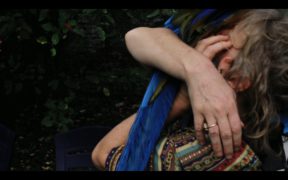
Linda Ibbari a saisi une relation particulière : celle que quatre femmes vivent et entretiennent avec leur animal domestique. Devant son objectif complice, elles anthropomorphisent leur bestiole, leur parlent comme à un ami, un enfant, une personne. Mais parfois, surgit la confusion d’une animalité conjuguée.
Un visage, les yeux mi-clos, dodeline, bercé par le ronronnement qui envahit l’espace sonore. Dans le plan suivant, un dogue, cadré serré, halète sous les caresses langoureuses de sa Maîtresse. Un corps-animal prolonge un corps-humain par le biais d’un raccord, qui les fait muter selon les lois d’une zooanthropie des plus communes. Domestique. Dans le sillage d’Ulrich Seidl (Tierische Liebe, 1995), Linda Ibbari a filmé Jenny, Luna, Elisabeta et Chantal, qui vouent une affection toute particulière et exclusive, à Tutule (chat-sphynx), Junkie (rottweiler), Monsieur Dupond (perroquet ara) et un magnifique python corail dont la propriétaire contemple, silencieuse et recueillie, le moindre mouvement d’anneau. Devant l’objectif de la cinéaste, les maîtresses jouent sans retenue avec leur objet d’amour, s’adressent à lui comme à un enfant ou une personne, alors que le montage, enlevé, construit précisément un espace de libertinage inter-espèces, plus comique que tragique, une zone de confusion où le langage articulé peut soudain devenir râles et cris, où l’humanité s’ensauvage au souvenir de son animale condition.
Emmanuel Chicon
Linda Ibbari has captured a special relationship: that which four women have and maintain with their pets. In front of her knowing lens, they anthropomorphise their animals, talk to them as if to a friend, a child, a person. But sometimes, there arises the confusion of a combined animality.
A face, eyes half-closed, nods, lulled by the purring that pervades the sound space. In the following shot, a mastiff, closely cropped, pants beneath the languid caresses of its mistress (Maîtresse). An animal-body extends a human-body through a match cut, which makes them mutate as per the laws of the most common zoanthropy. Domestic. In the wake of Ulrich Seidl (Tierische Liebe, 1995), Linda Ibbari filmed Jenny, Luna, Elisabeta and Chantal, who have a very particular and exclusive affection for Tutule (a sphynx cat), Junkie (a Rottweiler), Monsieur Dupond (a macaw) and a magnificent coral python whose owner silently contemplates every single movement of its coils. In front of the filmmaker’s lens, the mistresses play unrestrainedly with their objects of love, talking to them as if to a person, while the spirited editing accurately constructs a space of inter-species libertinism, more comic than tragic; a zone of confusion in which the language articulated can suddenly become gasps and cries, where humanity returns to the wild in remembrance of its animal condition.
Emmanuel Chicon
Ein Gesicht mit halb geschlossene Augen taumelt im sanften Schnurren, das den akustischen Raum erfüllt. In der nächsten Einstellung hechelt eine Dogge in Nahaufnahme unter den Liebkosungen ihrer Herrin (Maîtressen). Ein Tierkörper wird durch einen Match Cut, der sie nach den Gesetzen einer der häufigsten Arten von Zooanthropie mutieren lässt, zur Erweiterung des Menschenkörpers. Domestiziert. Auf den Spuren von Ulrich Seidl (Tierische Liebe, 1995) filmt Linda Ibbari Jenny, Luna, Elisabeta und Chantal, die eine ganz besondere Zuneigung für Tutule (Sphynx-Katze), Junkie (Rottweiler), Monsieur Dupond (Ara) und eine prächtige Python, deren Besitzerin ihre kaum sichtbaren Bewegungen still und andächtig betrachtet, hegen. Vor dem Objektiv der Filmemacherin spielen die Herrinnen hemmungslos mit dem Objekt ihrer Liebe, sprechen mit ihm wie mit einem Kind oder einer Person, während der virtuose Schnitt präzise einen anstandslosen Interspezies-Raum konstruiert, mehr komisch als tragisch, eine Zone der Verwirrung, in der die artikulierte Sprache plötzlich Stöhnen oder Schrei wird, wo die Menschlichkeit, sich ihres tierischen Daseins erinnernd, verwildert.
Emmanuel Chicon
Linda Ibbari
Julie Freres
GSARA ASBL