Visions du Réel is privileged and honoured to announce that the eminent Ukrainian filmmaker, Sergei Loznitsa, will be the Special Guest at the 57th edition of the Festival. On Saturday 18 April, Sergei Loznitsa will participate in the next edition of the Festival with a masterclass in collaboration with Arte and the Geneva University of Art and Design (HEAD). A selected retrospective of his documentary work will also be part of the Official Selection.
Following in the tradition of the Soviet avant-garde, his cinema explores the post-Soviet territory and memory through its upheavals and cycles of violence. Built around a quasi-mathematical formalism with frequent use of historical archives, his work observes the march of history, often haunted by its authoritarian excesses, while exploring the memory processes that account for the tragedies of the past.
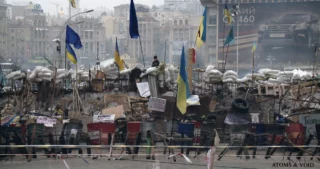
- Saturday 18 April, 10:30 – Maidan, Usine à Gaz 1 – In presence of the director
- Saturday 18 April, 14:30 – Masterclass with Sergei Loznitsa, Usine à Gaz 2
- Sunday 19 April, 10:45 – Donbass, Usine à Gaz 1 – In presence of the director
Before becoming a key figure in the contemporary film landscape, Sergei Loznitsa, a graduate in engineering and mathematics, worked as a scientist specialising in artificial intelligence at the Institute of Cybernetics in Kyiv. He studied film at the time of the collapse of the USSR and today has 28 feature-length documentaries and five fiction films to his name. His works display a vision of the post-Soviet era that is as arresting as it is fascinating, and demonstrate a sharp analytical and critical approach to history.
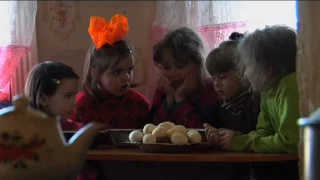
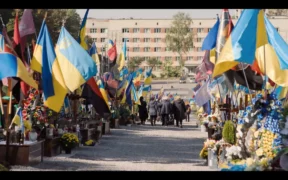
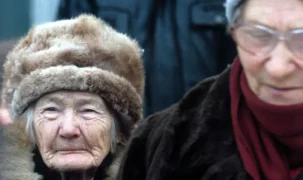
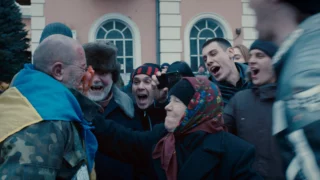
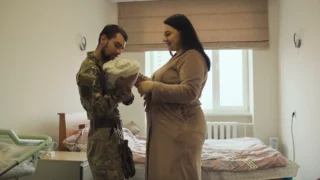
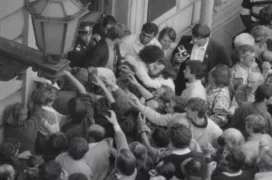
Devoid of commentary, his raw footage documentaries, which mainly comprise static shots, focus on observing both current events and the traumas of the past. Three of his films take the pulse of Ukraine’s political situation and the places where history is being written. With Maidan (2014), made in just 4 months and presented in a special screening at the Festival de Cannes, Sergei Loznitsa chronicles the demonstrations that triggered the Ukrainian Revolution in a structuralist fresco with no hero other than a political community in the process of being built. In Donbass (2018), whose script was based on amateur videos found on YouTube, the filmmaker depicts the takeover of the Donbass region by Russian-speaking militias who entered into conflict with the Ukrainian army. In thirteen sequences composed like paintings, his film describes the daily lives of the inhabitants, caught between loyalty and separatism. Finally, with The Invasion (2024), Sergei Loznitsa continues his Ukrainian chronicles with a film about his country’s struggle against the Russian invasion. Filmed over a period of two years, the film depicts the lives of civilians across the Ukrainian territory and captures the population’s resilience in the face of the Russian war of aggression.
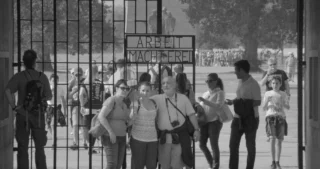
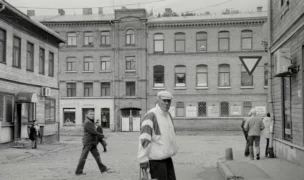
Austerlitz (2016) examines the trivialisation of Holocaust memory and uses lingering black and white static shots to capture tourists visiting a former concentration camp turned memorial. Sergei Loznitsa’s work indeed distinguishes itself also by several compilation films constructed from pre-existing material, in which the dissonance between image and sound serves as the organising principle. They are based on archival research, its reworking through editing and other formal choices, particularly in terms of sound design where the essential work of Vladimir Golovnitsky, his dedicated sound engineer since 2003, shines.
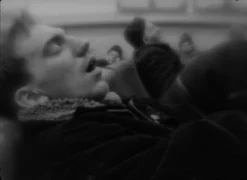
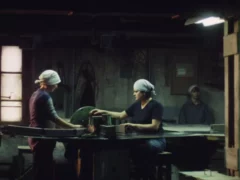
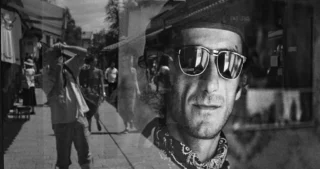
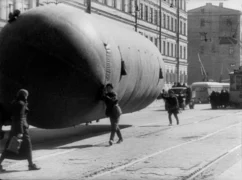
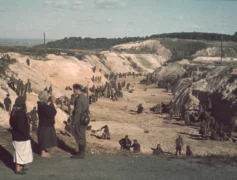
This artistic approach allows Sergei Loznitsa not only to explore the blind spots of Soviet history but also to create a dialogue between the past and the present, by questioning the processes that shape the creation of post-communist collective memory. Blockade (2005) was thus assembled solely from footage shot during the Siege of Leningrad (8 September 1941 – 27 January 1944) and leaves the war off-screen, focusing on the day-to-day survival of the population. Using propaganda footage and newsreels, Predstavlenie (2008) records Soviet life in the 1950s and 1960s, while The Event (2015) revisits the August 1991 coup in Moscow. Screened at Nyon in 2020, State Funeral (2019) explores the issue of the cult of personality by using as its corpus the film archives of Stalin’s funeral in 1953. Presented at a special screening at the Festival de Cannes, Babi Yar. Context (2021) unfolds without narration, recounting the largest massacre of Jews in World War II, which took place near Kyiv. Through his editing and the sound design of the archive footage, Sergei Loznitsa recreates the events that led to the execution of more than 33,000 Jews by the German Einsatzgruppen in 1941. The film was notably awarded L’Œil d’or’s Special Jury Prize at the Festival de Cannes.
Sergei Loznitsa is a filmmaker, screenwriter and producer. He was born on 5 September 1964 in former USSR and grew up in Kyiv. After obtaining his degree in applied mathematics from the Polytechnic School in Kyiv in 1987, he worked as an artificial intelligence researcher at the Institute of Cybernetics in Kyiv from 1987 to 1991.
In 1997, Sergei Loznitsa graduated with a degree in film studies from the renowned Russian State University of Cinematography (VGIK) in Moscow. Since then, he has developed his art internationally, making 28 documentaries and five fiction films.
His first feature film, My Joy (2010), was screened in the main competition at the Festival de Cannes, followed two years later by In the Fog (2012), a fiction film which won the FIPRESCI Prize on the Croisette. In 2014, the filmmaker returned to Cannes to present Maidan at a special world première screening. In 2017, his third fiction feature film, A Gentle Creature, joined the Cannes competition. In 2018, the Ukrainian filmmaker won the Un Certain Regard prize for Donbass, then awarded L’Œil d’or’s Special Jury Prize at the Festival de Cannes for his film Babi Yar. Context in 2021. Now a regular on the Croisette, Sergei Loznitsa presented the world première of The Invasion (2024) and Two Prosecutors (2025), his latest fiction film, which competed for the Palme d’Or at the last Festival de Cannes. His other films, The Event (2015), Austerlitz (2016), State Funeral (2019) and The Kiev Trial (2022) were given special screenings at the Venice Film Festival.
Sergei Loznitsa is also the founder of the production company ATOMS & VOID. Since the early 2000s he has been based in Germany and Lithuania.