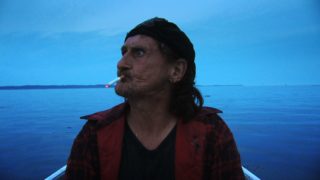
Sherman vit dans un lieu inconnu et lointain. Le jour, il ramasse des palourdes ; la nuit, il travaille seul dans une poissonnerie industrielle, absorbé dans un monde intérieur, préparant les outils de l’équipe d’ouvriers de six heures du matin. Au calme et à la marginalité de Sherman, à un certain isolement, s’oppose alors brièvement la violence engendrée par la consommation moderne.A travers la puissance d’une image et d’un son magistraux se construit une narration faite de plans lents et minimaux, reposant sur l’observation d’un personnage aux traits singuliers. Evoquant par moment le film d’horreur, Night Labor se déploie en un mystère lyrique et pictural, empli de contrastes. Familiarisés lors de leurs études au Film Study Center de l’Université de Harvard à des films tels que Leviathan de Véréna Paravel et Lucien Castaing-Taylor, les deux réalisateurs se sont intéressés « à la forme et à la couleur comme de possibles façons de montrer des histoires. Le langage devient obsolète, et le silence et les sons notre palette. Sherman […] ressemble au monde qu’il habite ». (AS/DR)
Sherman lives in a remote and forgotten place. By day, he digs for clams; by night, he works alone in an industrial fishmonger’s, absorbed in an inner world, preparing the work tools for the 6 a.m. shift. Sherman’s calmness and marginalisation, his sense of isolation, is then briefly contrasted with the violence generated by modern consumerism.A narrative of slow, minimalist takes, relying on observation and a personality with exceptional traits, builds through a combination of powerful and remarkable sound. At times reminiscent of a horror film, Night Labor unfolds in lyrical and pictorial mystery, full of contrasts. Familiar from their studies at the Film Study Center of Harvard University with work such as Leviathanby Véréna Paravel and Lucien Castaing-Taylor, the two directors became “interested in form and colour as ways to show stories. Language became obsolete and silence and environmental sounds became our palette. Sherman […] resembles the world he inhabits”. (AS/DR)Emilie Bujès
Sherman lebt an einem unbekannten, fernen Ort. Tagsüber sammelt er Venusmuscheln, abends arbeitet er – vollkommen in seine eigene innere Welt versunken – alleine in einer Fischfabrik und bereitet die Werkzeuge für die Frühschicht um sechs Uhr vor. Der mit einer gewissen Isolation verbundenen Ruhe und Marginalität Shermans ist hier als kurzer Ausschnitt die Gewalttätigkeit des modernen Konsums entgegengesetzt.In langsamen, minimalistischen Einstellungen baut sich aus eindringlichen Bildern und meisterhaftem Ton eine Erzählung auf, getragen von der Beobachtung einer Person mit markanten Gesichtszügen. Night Labor – streckenweise an einen Horrorfilm erinnernd – entfaltet sich zu einem lyrischen und bildhaften Mysterium voller Kontraste. Die Regisseure Verena Paravel und Lucien Castaing-Taylor, die während ihres Studiums am Film Study Center der Universität Harvard mit Filmen wie Leviathan in Kontakt gekommen waren, haben sich dafür interessiert, «Form und Farbe als mögliche Arten, Geschichten zu zeigen. Sprache wird obsolet, Ruhe und Klänge sind unsere Ausdruckspalette; Sherman […] ähnelt der Welt, die er bewohnt».
David Redmon
Ashley Sabin